

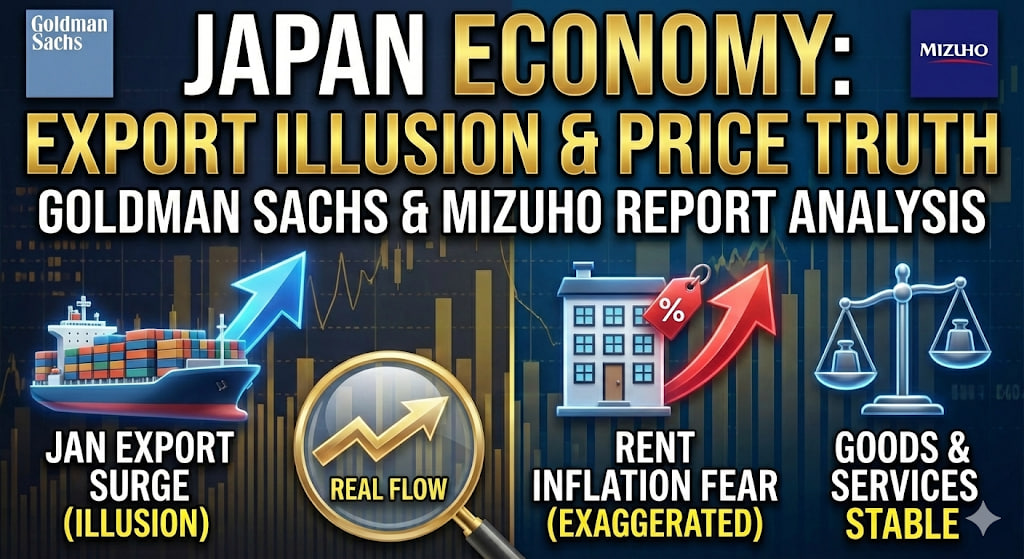
Examining the True Trends in Japan's Exports and Prices - The Illusion of Export Indicators and the Reality of Rent Inflation Fears
[GS & Mizuho Japan Economic Analysis Report / 26.02.18]
Examining the True Trends in Japan's Exports and Prices
Subtitle: The Illusion of Export Indicators and the Reality of Rent Inflation Fears
3-Line Summary
- Export Illusion: The 16.8% surge in Japan's January exports is largely due to the base effect from the difference in timing of the Lunar New Year, and the true trend can only be determined by averaging the figures for January and February.
- Quality of Exports: Despite tariff concerns, Japan's major exports to the U.S. (semiconductor manufacturing equipment, passenger cars, etc.) are showing a recovery based on solid demand.
- Price Overstatement: The impact of the 'rent increase' that the media is concerned about on the overall price level (Core-core CPI) is limited, and the key is the pace of stabilization of 'goods and other services prices'.
Detailed Analysis
■ 1. Lunar New Year Effect Creates Surprise Export Rebound (GS)
Japan's January exports increased by +16.8% year-on-year, and the trade deficit narrowed, giving the appearance of explosive improvement in trade conditions. However, Goldman Sachs analyzed this as a 'Lunar New Year effect'. The Lunar New Year, which was at the end of January to early February last year, shifted to mid-February this year, resulting in a temporary 'base effect' due to the increased number of operating days compared to January last year. To accurately grasp the underlying trend, the data for January and February must be combined.
■ 2. Robust Exports to the U.S. Overcoming Tariff Concerns (GS)
The real data that Goldman Sachs positively assessed is the 'resilience of exports to the U.S.'. Despite significant concerns about U.S. tariff impositions, major items are performing well.
- Semiconductor Manufacturing Equipment: After a significant decrease last year (-30.9%), it turned upward in January (+8.5%).
- Passenger Cars: January export volume to the U.S. turned upward compared to the previous month (+5.6%), and export prices also stabilized from their peak as tariff reductions (27.5% -> 15.0%) were reflected, but remained at a high level. This is evidence of solid demand for Japanese cars in the U.S.
■ 3. Exaggerated Inflation Surge Driven by Rent Increases (Mizuho)
Recently, Tokyo rents have risen by 1.5%, and concerns about uncontrollable inflation are spreading through the media. However, Mizuho Securities refutes this with objective figures.
- Even if the rent increase rate rises by 1.0%p, the effect of pushing up the overall price level (Core-core CPI) is only 0.2%p.
- Even in an extreme scenario where rents surge by 3.0%, the contribution to inflation is limited to +0.56%p, and there is no destructive power to shake the overall price trend.
■ 4. The Real Variables for Prices are 'Goods' and 'Wages (Other Services)'
Mizuho emphasized that the real key drivers of price movements are 'goods prices (+2.1%p contribution)' and 'other service prices excluding rent (+0.7%p contribution)', which reflect wages. As the upward trend in goods prices, such as food, is expected to slow down in the future, even if rents rise somewhat, Japan's core inflation is likely to stabilize at a level slightly below the BOJ's target (2%) from the second quarter of 2026, at around 1.5% to 2.0%.
StockHub Insight & Comments
This report accurately points out the 'traps of numbers' hidden behind the sensational headlines (export surge, inflation surge driven by rent increases) flooding the market.
From an investor's perspective, when looking at the Japanese market, rather than being excited by the illusion of short-term January export figures, attention should be paid to the strong fundamentals of automobile and semiconductor materials, parts, and equipment (SoBuJang) companies that are performing well in the U.S. market despite tariff headwinds. In addition, Mizuho's analysis that the inflation risk, which was feared to derail the BOJ's interest rate hike steps, has been exaggerated suggests that one of the uncertainties weighing on the Japanese stock market is being lifted.