

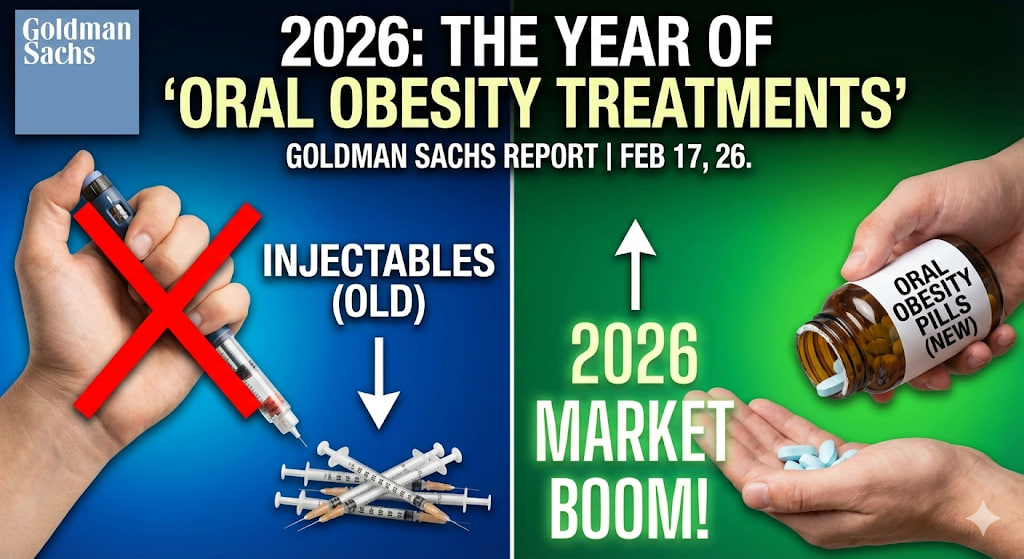
2026: The Year of "Oral Obesity Medications
[Goldman Sachs Pharma/Biotech Report / 26.02.17]
2026: The Year of 'Oral Obesity Treatments'
Subtitle: Obesity Treatment Market Evolving from Injectables to Pills, and into Consumer Goods
3-Line Summary
- Paradigm Shift: 2026 will mark the year when obesity treatments transition from injectables to oral forms (pills), becoming consumed like popular consumer goods.
- Novo Nordisk (Buy): Oral Wegovy, launched in January, is absorbing new latent demand from those averse to injections, recording unprecedented initial prescription rates.
- Eli Lilly (Buy): Orforglipron, scheduled for release in Q2, is also expected to perform strongly, with Lilly projected to lead the oral market in the long term by 2030.
Detailed Analysis
■ 1. Novo Nordisk: Unprecedented Initial Surge
Oral Wegovy, launched in early January this year, is showing explosive initial adoption rates as it enters its fifth week since launch. The key is that 'completely new users' who had postponed treatment due to injection aversion are entering the market, rather than existing injectable patients switching over.
Goldman Sachs has opened up its 2026 sales forecast for oral Wegovy to a maximum of $2.5 billion, far exceeding the existing market consensus ($800 million). If this surge continues, there is potential for an additional 1-9% increase in 2026 EBIT compared to previous forecasts, which will be a strong catalyst for a rebound in the stock price, which had been sluggish.
■ 2. Eli Lilly: Launching in Q2, Expanding the Market Pie
Market opinions on the 2026 sales forecast for Lilly's oral treatment 'Orforglipron,' scheduled for release in Q2, vary widely from $300 million to $4 billion.
Goldman Sachs, benchmarking Novo's initial data, presented a mid-case revenue of $2 billion as the most reasonable scenario. This is an upward revision from its previous forecast ($1.5 billion). Lilly's management also expressed confidence that the competitor's strong performance is a positive sign that expands the overall obesity drug market, and concerns that the new drug will cannibalize the existing injectable market were also analyzed to be minimal.
■ 3. Basis of Analysis: From 'Patient' to 'Consumer'-Driven Market
Goldman Sachs assumed that 70% of total prescriptions will occur through DTC (Direct-To-Consumer) channels, where pharmaceutical companies market directly to consumers. In other words, a huge consumer-driven market is forming, where patients actively request doctors to "prescribe this drug."
■ 4. Long-Term Outlook for 2030: Who Will Be the Ultimate Winner?
The overall obesity treatment market is projected to grow to approximately $101 billion by 2030, with the oral market accounting for $35.5 billion. Interestingly, in the long run, Lilly's new drug is expected to take the lead, occupying the majority of the market (approximately $19 billion), with Novo's Wegovy ranking second (approximately $5.8 billion).
StockHub Insight & Comments
The key takeaway from this Goldman Sachs report is the 'Consumerization' of obesity treatments.
In the past, people went to the hospital to treat diseases and relied on doctors' passive prescriptions. Now, we are moving into an era where consumers directly choose and consume brands, just like buying diet supplements or nutritional supplements. As the huge psychological barrier of injection needles is being broken down by 'pills,' the enormous latent demand that has been hidden is exploding.
In particular, the projection of the oral market size to $35.5 billion (approximately 47 trillion KRW) in 2030 and the prediction of a long-term duopoly between Lilly and Novo Nordisk (with Lilly's dominance) can serve as an important milestone when constructing a mid- to long-term healthcare portfolio. In the short term, the prescription data that will be confirmed immediately after the launch of Eli Lilly's new drug in the second quarter of this year will be the most important catalyst that will determine the direction of the two pharmaceutical companies' stock prices.