

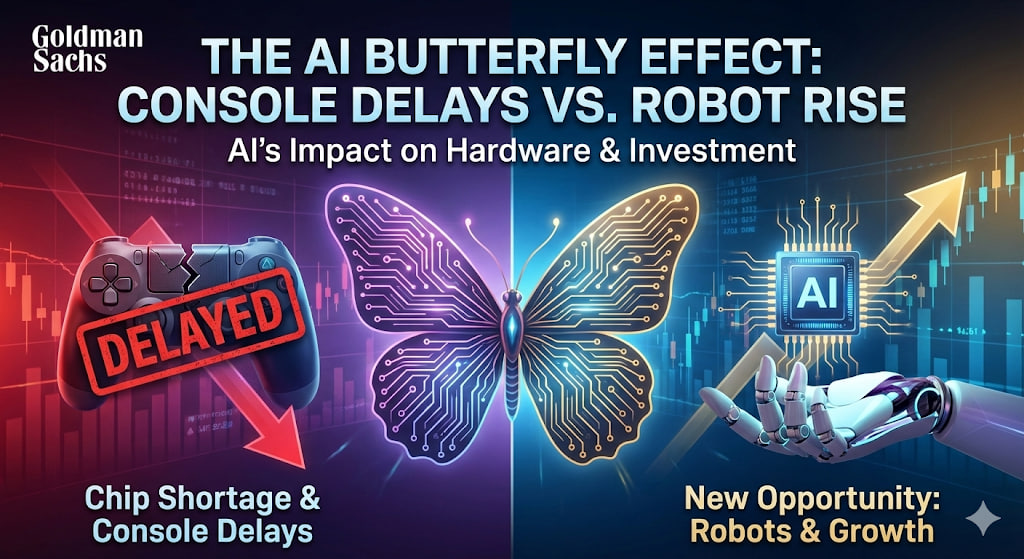
The Butterfly Effect Triggered by AI: Delayed Game Console Release and the Rise of Robots
[Goldman Sachs TMT Sector Report / 26.02.18]
The Butterfly Effect of AI: Game Console Launch Delays and the Rise of Robots
Subtitle: AI's Impact Spreads to the Hardware Market and Investment Points
3-Line Summary
- Component Crunch: The DRAM "black hole" phenomenon in AI data centers is making price increases for general PCs and delays in the launch of console game consoles such as PlayStation 6 increasingly visible.
- Rise of Robots: The semiconductor industry is focusing on the scalability of applying autonomous driving chips directly to humanoid robots, viewing robots as a new revenue source comparable to a second data center.
- Importance of IP: With the emergence of high-quality AI-generated videos drastically reducing video production costs, the profitability of media companies with unique intellectual property (IP) is expected to maximize.
Detailed Analysis
■ 1. AI-Driven DRAM Shortage and Consumer Impact
Hardware supply chain experts predict that the DRAM shortage will continue until at least mid-2027. This is because AI data centers are absorbing massive amounts of memory chips, leaving a scarcity of components for general consumer devices.
- PC Market Impact: Manufacturers are considering a 10-15% PC price increase to reflect rising component costs and are expected to focus on producing higher-margin commercial PCs. This puts companies like HP (HPQ), which have a high proportion of general consumers, at a disadvantage.
- Game Console Launch Delays: Sony is considering postponing the launch of PlayStation 6 to 2028-2029, later than initially expected, and the possibility of a price increase for Nintendo Switch 2 has also increased.
■ 2. Robots Emerge as the Second Data Center
The CEO of German semiconductor company Infineon emphasized that humanoid robots will become a huge growth area comparable to AI data centers. The existing chip portfolio developed for autonomous vehicles can be applied directly to robots, opening up a perfect new market that can alleviate margin pressure without additional development costs.
■ 3. Advancement of AI Video and the Victory of IP (Intellectual Property)
The AI video of Tom Cruise and Brad Pitt created with Seedance 2.0 heralds a fundamental change in the content market. While it poses a significant threat to physical studio infrastructure and actors, the barrier to production costs has been broken down, allowing blockbuster-level quality to be achieved with only a fraction of the previous cost. This suggests that who has the most powerful IP in the market is the key investment point.
■ 4. Confidence Signals from Companies and Other Trends
- Positive Signals from Management: The CEO of software company ServiceNow (NOW) abruptly canceled regular sales and directly purchased $3 million worth of its own shares, signaling the company's undervaluation to the market. Cadence (CDNS) also emphasized that AI functions are directly translating into real additional revenue.
- NVIDIA's Expansion: NVIDIA's acquisition of a 3% stake in Nokia has been confirmed, raising expectations for synergy between communication equipment and AI technology in the future.
- Apple's Wearable Counterattack: Apple is accelerating the development of AI-based wearable devices such as glasses and pendants, preparing for a head-to-head battle with OpenAI, which will soon unveil its own devices.
StockHub Insight & Comments
The most noteworthy change in this report is the impact of advanced AI video generation technology such as Seedance 2.0 on the industry as a whole.
As high-quality videos and images can be easily implemented and modified with prompt control, Hollywood's production system, which required enormous capital, is rapidly being dismantled. On the other hand, for companies that monopolize original characters and worldviews that can excite the public without such a huge infrastructure, the best revenue-generating stage has opened up, allowing them to visualize imaginative ideas at dramatically lower costs.
In addition, the memory chip shortage caused by AI data centers is interesting from a hardware perspective. The semiconductor industry's agile move to find a new breakthrough by transplanting autonomous driving chips for automobiles into robots will be a very important yardstick for selecting promising hardware companies in the future.