

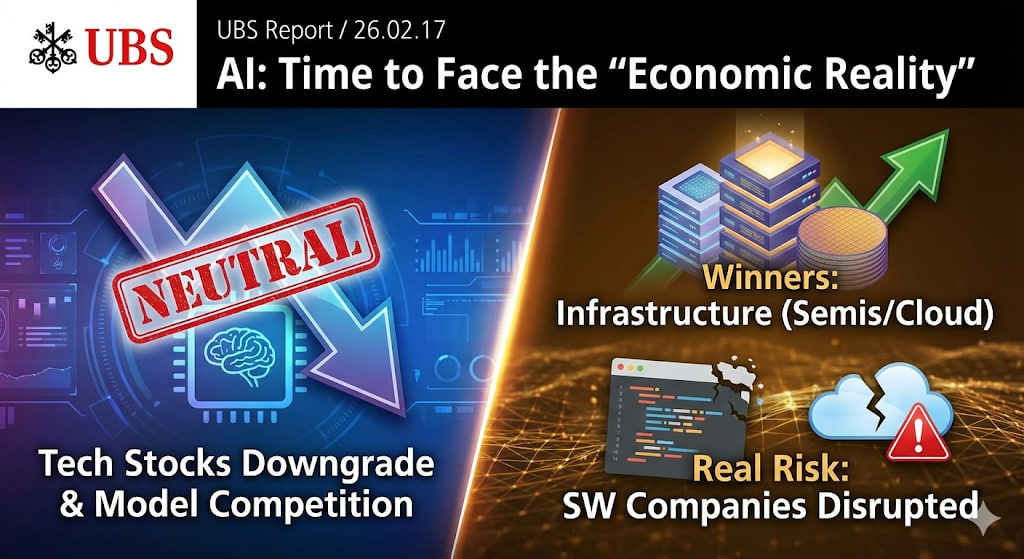
UBS US Tech Strategy: AI, Time to Face the 'Economic Reality'
[UBS US Tech Strategy / 26.02.17]
AI: Time to Face the 'Economic Reality'
Subtitle: The Background of the Downgrade to 'Neutral' on Tech Stocks and the Real Risks
3-Line Summary
- Downgrade: UBS has made an unusual decision to lower its investment opinion on US tech stocks to neutral, judging that the AI model market has entered a state of perfect competition, making it difficult to generate excess profits.
- Real Risks: While Big Tech's massive debt is not a problem as the market can sufficiently absorb it, there are significant concerns about the potential insolvency of existing software companies whose business models are being destroyed by AI advancements.
- Investment Strategy: Warning against broad-based tech stock purchases, UBS advises concentrating capital on essential infrastructure (semiconductors, cloud computing) that will inevitably benefit regardless of who wins.
Detailed Analysis
■ 1. AI's Diminished Profitability: Entering Perfect Competition
The biggest concern is when the massive AI investment costs will translate into profits. The current AI model market, where numerous research labs compete and barriers to entry have lowered, is economically similar to a state of perfect competition, making it difficult to generate excess profits. Unless it is reorganized into an oligopolistic form, it will be difficult to leave the expected margin.
■ 2. Big Tech's Massive Debt is Not a Problem

The AI investment of major hyperscalers such as Microsoft and Google this year amounts to $675 billion, and they are increasing external borrowing to finance this. However, their credit metrics are still excellent, and the liquidity of the investment grade (IG) corporate bond market is abundant, so this level of debt can be sufficiently absorbed. The possibility of Big Tech collapsing due to debt is small.

■ 3. The Real Danger: Software Companies Being Disrupted
The real risk lies in lower-tier software companies that are losing work due to AI technology. As AI agents from Anthropic, OpenAI, etc., replace coding, legal, and consulting tasks, the stock prices of service companies such as RELX and AON have been significantly impacted. Google has already revealed that AI is writing 50% of its entire code, demonstrating that the productivity revolution is becoming a threat to the survival of existing companies.
■ 4. Gradually Approaching Credit Risk

A significant portion of the debt of these software companies, whose business models are faltering, is exposed to high-risk private credit (approximately 20%) or leveraged loans (approximately 14%). However, as private equity funds have an incentive to provide liquidity support, this crisis is expected to smolder slowly rather than erupt all at once.
■ 5. Conclusion: Focus on Infrastructure and Separate the Wheat from the Chaff
It is time to abandon unconditional optimism about tech stocks. Instead of simply buying tech stocks, the threat to the business model must be carefully considered. Rather than focusing on the highly uncertain application software sector, it is wise to pay attention to infrastructure sectors such as semiconductors and cloud computing, which are essential in the AI era regardless of who wins.
StockHub Insight & Comments
This UBS report pours cold water on the blind AI optimism that had been prevalent in the market, posing a very cold and realistic question to investors. "How will you ultimately make money with that massive cost?"
As AI develops, the camp that benefits and the camp that is thoroughly destroyed are clearly divided. The emergence of AI agents that code and review documents themselves is innovative, but it is a crisis of survival for many software (SaaS) companies that previously provided those services and generated revenue.
In this phase of separating the wheat from the chaff, the classic strategy of investing in companies (semiconductor and cloud infrastructure) that sell picks and shovels and jeans to the many people (AI software companies) trying to mine gold is the safest and most reliable profit model.