
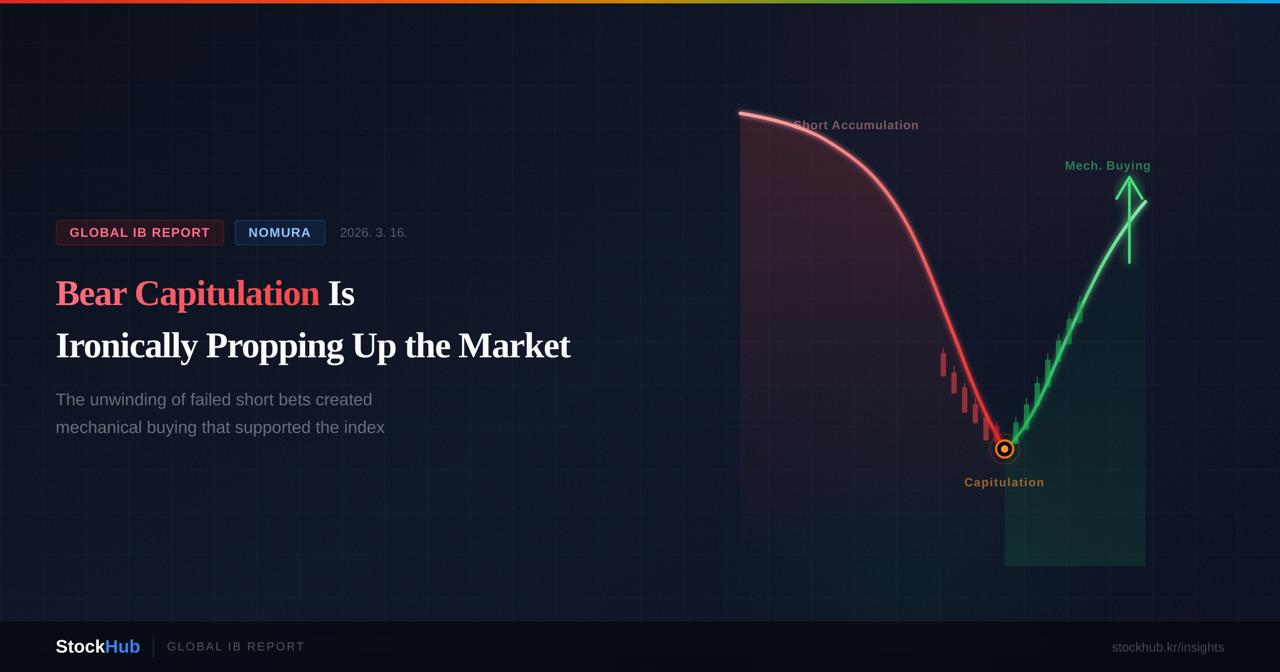
Nomura: Investor Capitulation on Shorts Bolsters Market, Revealing Resilience
The Reason the Market Didn't Collapse Wasn't Optimism, But the Liquidation of Bearish Bets Unwilling to Endure Losses
Original Report Publication Date: March 16, 2026
3-Line Summary
- Nomura diagnosed that the recent stock market has entered a frustrating sideways phase, neither a sharp decline nor a sharp rise.
- Investors who bought put options and volatility in preparation for a market collapse are unexpectedly increasing their losses, and the liquidation of their positions is creating mechanical buying pressure, according to the report.
- In essence, the core of this report is that the force supporting the market is not strong fundamentals, but the "capitulation buyback" of funds that had bet on a decline.
1. The Market Has Entered Its Most Difficult Phase
Nomura assessed that the current market has entered a more challenging phase than a simple correction. The explanation is that the trend of stocks not rebounding decisively, nor experiencing a panic-driven collapse, is creating the most fatiguing market for investors.
The background to this is the weakening momentum of existing market leaders. The Magnificent 7 and AI-related stocks are no longer strongly driving the index higher, but the rest of the stocks are not strong enough to create an upward trend in their place.
Nomura specifically saw the following pressures weighing on the market:
- Cyclical stocks are vulnerable to concerns about slowing growth.
- The AI sector faces growing market skepticism regarding the burden of large capital expenditures.
- The index lacks upward breakout momentum, but at the same time, the shock that would cause a downward collapse is limited.
Ultimately, the current market is interpreted as a phase where "time" is more of a torment to investors than directionality.
2. Those Who Prepared for a Decline Are Actually Suffering the Biggest Losses
The most striking aspect of this report is that the entities suffering the most in the current market are not the optimists, but the investors who prepared for downside risk.
In recent weeks, various negative factors have accumulated in the market. Geopolitical risks related to Iran, concerns about resurgent inflation, interest rate volatility, the possibility of a slowdown in the US labor market, and private credit instability were representative examples. Consequently, many investors built defensive positions, such as put options, in preparation for a sharp stock market decline.
However, the actual market did not collapse as expected. As the sideways trend lengthened without a sharp decline, the downside protection positions failed to generate profits, accumulating only time decay losses. Nomura described this as investors who prepared for a decline experiencing "fear of the opposite direction."
The core of the issue does not end here. These positions are eventually liquidated. Due to the structure of the options market, selling put options or unwinding existing bearish bets can lead to mechanical stock buying by dealers. In other words, the moment funds that bet on a decline close their positions, automatic buying demand is generated in the market.
Nomura analyzed that the liquidation process related to put options in the recent SPY options market actually triggered strong delta buying, and this trend had a greater impact than simple call buying.
To summarize:
- Investors paid a cost to hedge against a decline.
- However, the market did not collapse.
- Ultimately, bearish bets that could not endure losses were liquidated.
- This liquidation process created mechanical buying pressure, supporting the index's downside.
In other words, one of the reasons the recent market has not easily collapsed is not strong optimism, but the self-reversal of bearish positions.
3. Volatility Buying Failed, Volatility Selling Profited
Nomura saw this trend clearly reflected in the volatility products market. For example, funds betting on a rise in volatility have been rapidly exiting VIX-related products.
There were clearly many factors of uncertainty in the market, but the actual price movements did not erupt as much as expected. Because of this, funds that positioned themselves expecting a sharp increase in volatility did not achieve the expected performance and were ultimately pressured to liquidate.
According to the report, VIX ETN funds betting on increased volatility saw outflows of approximately $40 million over the past month. This was assessed as the lowest level since the "Volatility Extinction on Liberation Day" in April 2025. From a dealer positioning perspective, demand for increased volatility fell to the 48th percentile of historical distribution.
Conversely, those who profited were those employing volatility selling strategies. Due to market anxiety, option prices remained high, but actual index volatility was limited. In other words, the environment of selling expensive options while actual volatility remained subdued favored short-volatility strategies.
Nomura assessed that hybrid structures, which some investors attempted to hedge against declines at a lower cost, also performed poorly.
For example:
- Structures betting on stock declines when oil prices rise.
- Structures betting on stock declines when interest rates rise.
These trades resulted in losses on both sides as the expected correlations in recent market movements did not function properly.
4. Institutions Are Already Extremely Defensive
Nomura viewed the current positioning of market participants as heavily skewed towards defense. In particular, institutional investors and asset managers were interpreted as having significantly reduced their equity exposure.
According to the report, asset managers' short positions in S&P 500 futures showed an extreme defensive stance, reaching the bottom 1% of historical distribution over the past week. This signifies more than just caution; it means a considerable number of investors have already reduced their exposure to risky assets.
What is interesting is that even in this situation, investors are still preparing for further declines. Nomura mentioned that at the time of writing the report, large purchases of S&P 500 6050 put options expiring in January 2027 were detected. This implies that despite the market holding steady, investor sentiment remains strongly tilted towards downside risk.
This structure has important implications for the market.
- Many investors have already reduced their stock allocations.
- Hedging against further declines still remains.
- Therefore, if the index begins to rebound contrary to expectations, delayed chasing buying could occur.
Nomura focused on this very point. If the market achieves a certain level of "escape velocity," investors who have positioned themselves excessively conservatively may eventually re-enter to catch up with the rise.
5. What's Supporting the Market Might Be Excessive Skepticism, Not Optimism
Nomura posed a simple question to its clients: What if the market becomes insensitive to negative news like Iranian risk, and stock prices begin to trend upward, even slightly?
Most investors still view the macroeconomic environment as too unstable and reacted with skepticism to such a rebound scenario. However, Nomura pointed out that this strong skepticism itself could become a factor supporting the market's downside.
The reason is clear:
- Investors believe the negative news and continue to pay hedging costs.
- However, if the market does not collapse, their positions incur increasing losses over time.
- Eventually, capitulation and liquidation occur.
- This liquidation, in turn, creates mechanical buying pressure, supporting the index.
In other words, the stronger the market consensus on negative news, the more excessive bearish bets accumulate, and if a collapse does not actually occur, those positions reverse and paradoxically support the market.
Nomura did not view the current market simply as "a market that doesn't fall because it's strong." Instead, it interpreted it as "a market that doesn't easily collapse because too many people are preparing for a decline."
StockHub Insight & Comments
The core of this Nomura report is that the recent stock market's resilience is not due to its strength, but because funds that bet on a decline are themselves supporting the market's bottom.
Typically, investors might easily interpret a stable market as strong buying pressure. However, entirely different events can unfold in the derivatives market. When excessive downside hedging accumulates and the market doesn't collapse, the time decay losses and underperformance of those positions accumulate, eventually leading to liquidation. This liquidation, in turn, creates a structure that connects to stock buying.
From this perspective, the recent market is likely a phase where the influence of positioning and the structure of the options market are playing a larger role than fundamental improvements. The fact that institutional investors have already retreated to a significantly defensive stance also suggests that the energy for further sharp declines may be more limited than expected.
However, this structure is not a permanent shield. If the reason the market can continue to hold steady is not earnings improvement or economic recovery, but mechanical supply and demand from position liquidation, it could be sensitive to new shocks when they occur. Therefore, it is more appropriate to view the current market phase not as a "bull market," but as a supply-and-demand driven market created by the reversal of pessimism.
Ultimately, the investment point lies in looking at positioning and the structure of the options market together, rather than simply interpreting news. When the index doesn't fall significantly despite numerous negative factors, it is necessary to identify the forced liquidations and mechanical buying flows hidden in the background.
Disclaimer
This content is a reconstructed informational material based on overseas reports and does not constitute a buy/sell recommendation or investment advice for any specific asset. Market interpretations and outlooks reflect data and perspectives at the time of writing and may change with future market environment shifts. All investment decisions and their resulting responsibilities lie with the investor.