
![[BofA Report] The Great Rotation of Smart Money: The M7 Monopoly Ends, the Era of 'Alpha' Begins](https://giuxbisydiqiapugqqmq.supabase.co/storage/v1/object/public/insights-thumbnails/thumb_1773210967364.jpg)
[BofA Report] The Great Rotation of Smart Money: The M7 Monopoly Ends, the Era of 'Alpha' Begins
Subtitle: Institutions Shift from Gold to Oil, and Cap-Weighted to Equal-Weighted Portfolios
Original Report Date: March 10, 2026
3-Line Summary
-
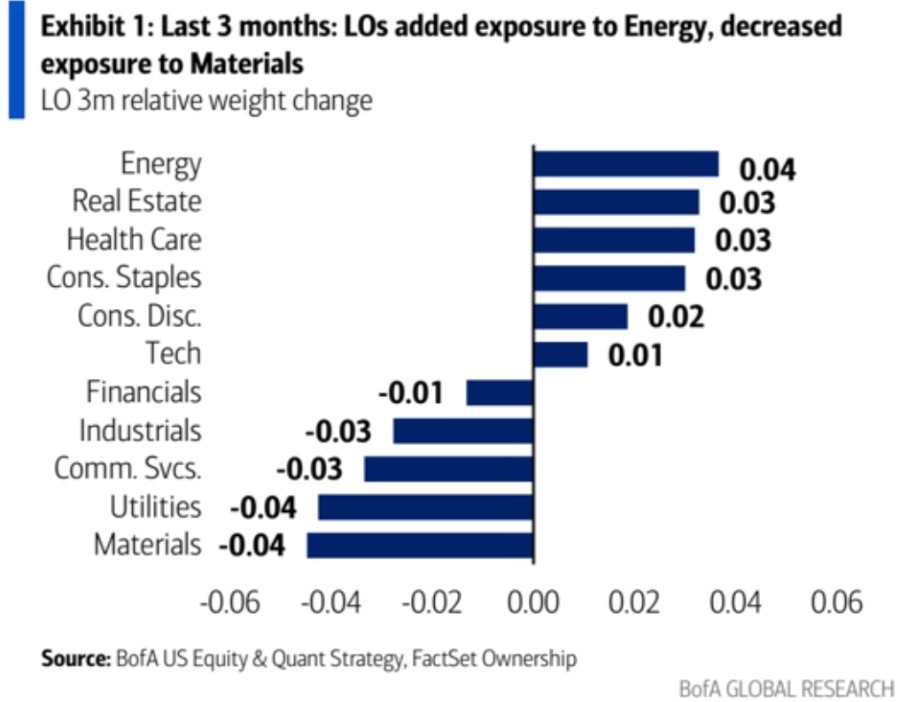
Rise of 'Black Gold' and Real Estate: Amidst geopolitical instability, long-only funds are aggressively slashing their safe-haven Gold positions while ramping up exposure to Energy (Crude Oil) and Real Estate sectors.
-
The Sidelined Value Stocks and Equal-Weight Boom: Despite being in a 'recovery' phase where Value outperforms Growth, institutions remain severely under-allocated to Value, offering a prime buying opportunity. Meanwhile, massive capital is flooding into 'Equal-Weight S&P 500 ETFs' to escape Big Tech concentration.
-
The Return of the 'Alpha' Market: With S&P 500 stock return dispersion spiking to its highest level since 2020, the era of passive indexing is giving way to a stock picker's market, where generating excess returns (Alpha) is paramount.
In-Depth Report Analysis
Every retail investor has likely wondered at some point: "What are institutional investors—the so-called 'Smart Money'—buying and selling right now?" Bank of America (BofA) issues a fascinating monthly report tracking market fund flows by analyzing the portfolio weights of active fund managers.
According to this month's BofA report, titled "What Are Your Neighbors Doing?", a 'Great Rotation' of capital that began in Q4 of last year is becoming distinctly clear. The report presents compelling data showing a massive paradigm shift as institutions pivot away from the mega-cap tech stocks (M7) that previously dominated the market. We dive deep into BofA's analysis of this portfolio restructuring and its implications.
1. Commodity Regime Change: Selling Gold to Buy 'Black Gold'
The first major trend BofA highlights is the extreme positioning shift within the Commodities and Energy sectors. With WTI crude oil surging roughly 70% from its YTD lows amid Middle East geopolitical tensions, 'Long-only' fund managers began aggressively overweighting the Energy sector starting in Q4.
Conversely, funds' net positioning in 'Gold futures' has plummeted. Gold positioning, which ranked in the high 81st percentile last summer, has nose-dived to the 51st percentile. Investors are moving massive amounts of capital out of the traditional safe haven of gold and into 'Black Gold' (Crude Oil).
2. Opportunity in Extreme Imbalance: The Counterattack of 'Value'
This year, traditional Value stocks (characterized by Low P/E) are outperforming Growth stocks. In fact, the Russell 1000 Value Index is outperforming its Growth counterpart by 8 percentage points year-to-date.
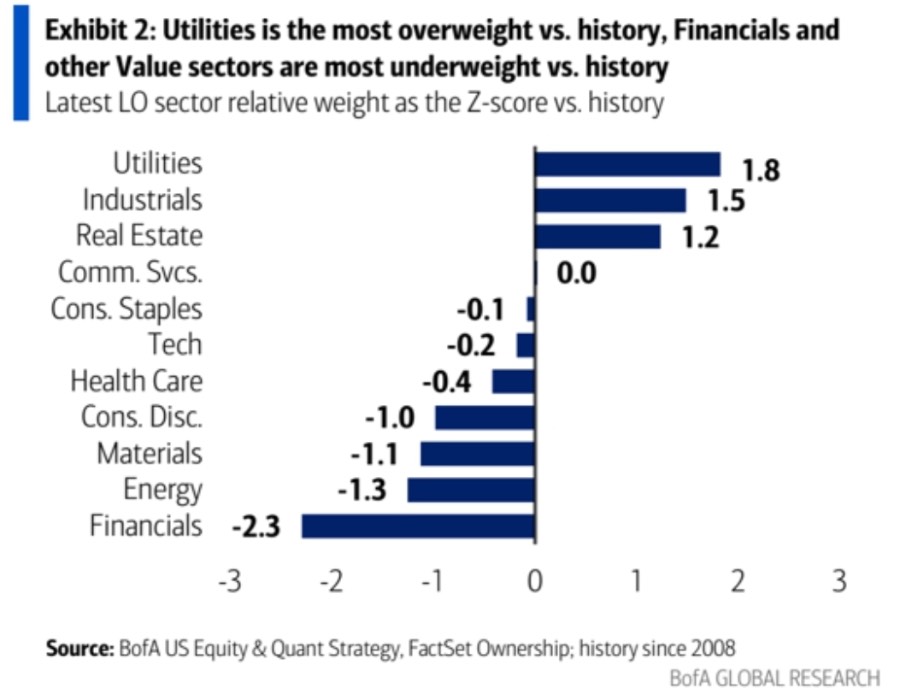
However, BofA points out a fascinating contradiction in fund managers' portfolios. Even as Value leads the market, Value factors remain the most severely 'under-owned' among all groups BofA tracks. On the flip side, institutional ownership of Private Equity (PE) and alternative asset managers remained stubbornly high, despite negative return momentum. In short: institutions are holding onto expensive underperforming assets while refusing to buy cheap outperforming assets (Value).
BofA analyzes that the US economy is showing signs of exiting a downturn and entering a 'Recovery' phase. Historically, Value and Small-cap stocks deliver their strongest performances during recoveries. Because market capital has not yet fully rotated into Value, BofA sees this as the perfect environment to pre-emptively accumulate these sidelined assets.
3. The Passive Investing Earthquake: Exodus to 'Equal-Weight' Indices
A massive tectonic shift is occurring in passive investing as capital floods out of the traditional capitalization-weighted S&P 500—which is heavily skewed by giants like Apple and Microsoft—and into 'Equal-Weight' indices, where all 500 companies share an identical 0.2% weighting.
Year-to-date, the Equal-Weight S&P 500 Index has outperformed the Cap-Weighted Index by 4 percentage points. Consequently, these equal-weight passive products have seen a staggering, record-breaking $15 billion in inflows in just the first 9 weeks of the year.
BofA interprets this as a decisive indicator that market breadth is widening; the driving force of the market is expanding from a handful of mega-caps to a diverse array of companies across the broader market. Furthermore, despite massive inflows, the P/E ratio of the equal-weight index remains more than 1 standard deviation below its historical average relative to the cap-weighted index, underscoring its valuation appeal.
4. The Return of 'Alpha': A Market Proving True Fund Manager Skill
For the past few years, the equity market was characterized by extreme concentration driven by the 'Magnificent 7' (M7). The crowding was so severe that just 5 stocks accounted for an average of 33% of active fund AUM.
However, the tables have completely turned in 2026. This year, roughly 60% of S&P 500 components are outperforming the index (compared to less than 30% over the past three years). The most critical metric here is 'Dispersion' (the variance in returns between individual stocks), which has spiked to its highest level since 2020. The market is no longer rising uniformly; there is a stark divergence in performance between good and bad stocks. BofA declares that the era of generating 'Alpha'—excess returns achieved through meticulous Stock Picking rather than passive index hugging—has finally arrived.
5. Hedge Fund (HF) Perspectives: Selling Utilities, Buying Materials/Industrials
How are aggressive hedge funds, which utilize short selling, positioning themselves? According to BofA data, hedge funds are currently shorting the Utilities sector the most aggressively within the S&P 500.
Conversely, the sectors with the highest 'Net Exposure' (Long positions minus Short positions) are Materials and Industrials (Energy and Consumer Staples ranked lowest).
Additionally, among individual stocks, the vaccine maker Moderna (MRNA) was highlighted as the most heavily shorted stock in the S&P 500, with short interest sitting at an overwhelming 18.3% of its free float, making it a prime target for hedge funds.
StockHub Insight & Comments
The movement of smart money provides definitive proof that the stock market paradigm is shifting entirely from a 'Big Tech Monopoly' to a 'Fundamentals-driven Stock Picker's Market'. The record-breaking inflows into Equal-Weight ETFs (like RSP) serve as powerful evidence that market participants are rotating away from valuation-stretched mega-caps to hunt for bargains among the other 490+ companies. With return dispersion hitting multi-year highs, surviving on 'blind index investing' alone will be increasingly difficult. As BofA points out, the time has come for 'Alpha' players—those who can unearth hidden gems grounded in solid earnings within the Value and Industrials sectors—to claim their victory.